
A Rainbow Baby’s Fighting Heart

When Melissa Wright found out she was pregnant in June of last year, she and her husband were overjoyed. Already parents to a son and daughter, the couple had always hoped to grow their family. Earlier that same year, however, Melissa had experienced a miscarriage, making the news of her pregnancy even more meaningful.
Melissa’s first trimester went smoothly, and by the time she reached her 20-week ultrasound appointment, she felt increasingly confident about welcoming her rainbow baby, a little girl, into the world.
Because of her age and previous miscarriage, Melissa attended regular appointments with a maternal-fetal medicine specialist for additional monitoring. During her 20-week ultrasound, a detailed scan used to evaluate a baby's growth and development, she noticed the technician spending extra time examining her baby’s heart. Not long afterward, her specialist explained that there were concerns about the baby's cardiac development.
Related Content
“She said the left side of the heart was measuring a little small,” Melissa recalled. “My husband and I were both in shock. We thought, ‘How can anything be wrong with our baby?’”
Melissa’s specialist referred her to pediatric cardiologist Dr. Monesha Gupta, director of the Fetal Cardiology Program at CHRISTUS Children’s.
“Dr. Gupta performed a fetal echocardiogram on our baby to get as much information about her condition as possible,” Melissa said. “Afterwards, she came back and said that it was what we had been told before, that the left side of her heart was small, but the good news was that all of her chambers were working nicely and that the flow in her heart was good.”
The news was encouraging, but Melissa understood there were still uncertainties ahead.
“Dr. Gupta said she would continue to track our baby’s development and that although she was optimistic she may never need surgery, she wouldn’t have all the answers until after our baby was born,” Melissa said.
Dr. Gupta continued monitoring Melissa and her baby throughout the remainder of the pregnancy. Through additional fetal echocardiograms, she was able to confirm that the baby's overall growth and development remained on track. Because Melissa had previously delivered by C-section, she and her care team determined that another C-section would be the safest option, especially given the uncertainty surrounding the baby's heart condition.


At 39 weeks gestation, baby Adeline was born at CHRISTUS Children’s in San Antonio.
“She came out crying and with a full head of hair,” Melissa recalled. “I got to see her for just a second before they took her to the NICU. My husband and I had already agreed ahead of time that he would go wherever she went, so I was glad to know he was with her.”
Shortly after delivery, Melissa developed postpartum preeclampsia, a condition that can occur after childbirth and is associated with a sudden rise in blood pressure. While her care team worked to stabilize her, another group of specialists cared for Adeline in the neonatal intensive care unit.
“That evening, the cardiologist came to visit me and explained everything that was wrong with Adeline’s heart,” Melissa recalled. “We also learned that she would need surgery after all.”
Adeline was diagnosed with coarctation of the aorta, a narrowing of the aorta, the major blood vessel that carries oxygen-rich blood from the heart to the rest of the body. According to the Centers for Disease Control and Prevention (CDC), approximately one in every 1,800 babies born in the United States each year has this condition.
She also had a bicuspid aortic valve, meaning the valve had two leaflets instead of the typical three, which can affect blood flow through the heart.
As Melissa recovered from her C-section, she worried about her newborn daughter. At the same time, she knew Adeline needed treatment and was receiving specialized care.
“Essentially, my heart was pumping for hers when she was in the womb,” Melissa said. “There was no question she needed surgery, but I hated the idea of having my baby placed on a heart bypass machine. She was just so tiny.”
A few days before surgery, Melissa received encouraging news from Adeline’s heart care team at The Heart Center at CHRISTUS Children's.
“He called to tell us that her aortic arch was larger than initially anticipated”,” Melissa said. “It was tiny, just a few millimeters, but large enough for him to work with. Best of all, it meant she met the minimum requirement to not have to have open-heart surgery.”
Melissa was told that instead, Adeline could undergo a lateral thoracotomy to repair the coarctation of the aorta.
Melissa and her husband were relieved that their daughter would not need cardiopulmonary bypass or a more invasive procedure involving the heart itself. Instead, at 11 days old, Adeline underwent the procedure to remove the narrowed portion of the aorta and restore normal blood flow.
“It is really scary seeing your daughter with the breathing tube in and all these medicines going into her, but she did great,” Melissa said. “She was in the PICU for a few days and then returned to the NICU.”
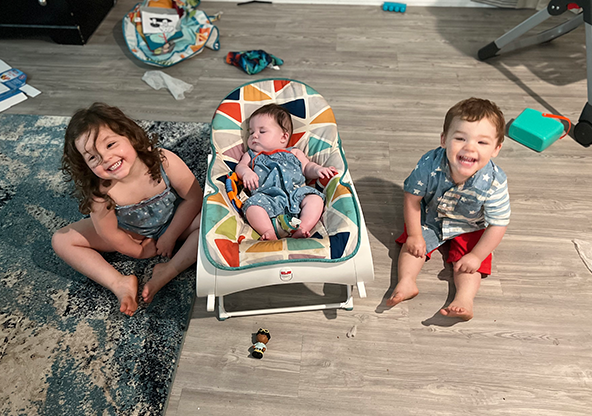
The surgery was successful, but Adeline faced additional challenges during recovery. She developed feeding difficulties and eventually an aversion to eating. In late April, physicians placed a gastrostomy tube (G-tube) to help ensure she received the nutrition needed to continue growing.
Melissa said she will always remember the care provided by Dr. Maria Pierce, M.D., a perinatal-neonatal medicine physician with CHRISTUS Children’s NICU in San Antonio.
“Dr. Pierce was wonderful. She always gave us the facts and didn’t sugarcoat anything, and she called regularly to let us know how Adeline was doing and she was always there to answer any of our questions,” Melissa said. “I also want to recognize our fabulous NICU nurses. It was nice knowing that she was in great hands when we were not able to be there for Adeline.”
Altogether, Adeline spent 67 days in the hospital before she was able to go home.
“Getting her to eat on her own is now her biggest hurdle,” Melissa said. “It’s scary for us. I was able to breastfeed my other two kids, so her having a G-tube is a whole different world.”
Melissa said she remains grateful for the support she received from CHRISTUS Children’s and for the connections she has made with resources and other parents navigating similar experiences.

“Everyone has been so great. The nurses, the doctors, the respiratory therapists, even the custodial staff,” Melissa said. “You would see them time and again and they would just stop to talk and ask how the baby was doing. It’s not their job, but you could tell they had an interest and they cared, and that really meant a lot.”
Although Adeline still has challenges ahead, she is a fighter who is deeply loved, and her parents remain full of hope and faith.
“It’s been overwhelming, but we’re so thankful for our baby girl, and already we’ve seen so many miracles,” said Melissa.